Friday, June 30, 2017

A European Superstate After Brexit and Trump--Rough Draft of a Talk

The Idea of a European Superstate after Brexit and Trump

Notes for a Talk Delivered  for Tocqueville Association June 29 2017, American University Paris


My question is this: 

“What form should Europe take in the wake of Brexit and Trump?”

Setting Brexit and Trump aside for the moment, there are—crudely stated—three different ways of thinking about the postwar political shape of Europe:

1.       A Europe of nation-states that fiercely guard their sovereignty (this is the Europe favoured by Nigel Farage and Madame Le Pen);

2.       An intergovernmental Europe that recognizes the centrality of nation-states, but which also establishes shared sovereignty over key economic functions (including trade and monetary policy)—the EU in its current form resembles this; and

3.       A Federal Europe that deprives current nations of their sovereignty over a wide range of functions, including taxation and spending, defense and foreign policy.  This Federal Europe—called by its enemies A European Superstate or A United States of Europe—is an aspiration of federalists but is widely dismissed as an impractical or utopian project.

I want to structure my answer around three Tocquevillean themes:

1.       New Types of Political Organization call for new ways of thinking, a new Political Science.

Tocqueville had in mind the new political form assumed by the new states, which managed to combine a democratic society and a decentralized republican form of self-government. 

From the perspective of historical sociology, we can identify a range of different political forms to have emerged in Europe over the last 1000, including the Medieval Regnum; the City State; the Absolute Monarchy; the Multinational Empire; the Constitutional Democracy; and—although it is difficult to situate it as a type—the European Union (EU).   

The EU has been described as the first fundamentally new macro-political form to emerge in over 500 years.  The EU poses an intellectual challenge for a number of reasons:

(i)                  it is in a constant state of flux (adding and subtracting members; adding but rarely subtracting powers or competences),
(ii)                it is not clear whether or how long it will survive; and
(iii)               it co-exists in perhaps a predatorial relationship with Europe’s nation-states.

Perhaps more intellectually challenging still, we do not have a clear idea what is required to maintain this new type of political organization. Does it need a shared language? Does it need common educational programs?


2.       Geography Matters.

Tocqueville was very conscious of the role that America’s geographical position played in making possible its decentralized republican form of government.  But he also saw the limitations of this form of government were it transplanted to Europe, which had a very different geographical position. As he noted:

A people which in the presence of the great military monarchies of Europe should divide its sovereignty into fractional parts would, in my opinion, by that very act abdicate its power and perhaps its existence and its name.
             
It remains a contested question whether the EU needs its own more potent military force. It is uncontestable, however, that Europe finds itself in a precarious geographical position. It is bounded on its Eastern border by Putin’s Russia; and is bounded on its Southern border by the Mediterranean and further South by the failed and failing states of Northern Africa. 

Geographical positions, in short, pose opportunities and challenges.  Tocqueville’s insight was to recognize that a form of government that worked for America might not work, at least in precisely the same form, in Europe.  For better or worse, Europe confronts a much more challenging geographical position than the USA, a position that poses major security and immigration problems.

3.        Centralization is sometimes advantageous and sometimes disadvantageous.          

One of Tocqueville’s great themes in Democracy in America and the The Old Regime is the impact of centralization on liberty, patriotism, and the quality of government. 

Tocqueville drew a useful distinction between political and administrative centralization.


II
The Challenge of Brexit and Trump

In different ways B and T challenge core elements of the post-war Western global order.  That order rested on the following three elements:
(i)                  Rule-based multilateral trade regime—aim to lower tariffs and promote regulated trade;
(ii)                NATO—an asymmetrical military alliance run by the Americans partly on behalf of the Europeans—held together by the glue of fear of the Soviet Union;
(iii)               EU—an American backed project to increase European unity and bind Europe around the core values of democracy and market capitalism.

Trump—at least in his Bannon/Breitbart clothes—is a major threat to this post-war global order.
The Five Elements of Trumpism
1.       America First—whether in trade relations or in security-matters;
2.       Nationalist Internationalism—allies with other nationalists—Putin, Modi;
3.       Anti-Immigrant Ethnocentrism—friendly with Nigel Farage; supports both Brexit and the break-up of the EU;
4.       Anti-NATO--Seeks new alliance structures—alliances with Russia and closer ties with Saudia Arabia 
5.       Anti-European values—human rights, climate change, multiculturalism, --see Pew Study.

Brexit presents less of a set of challenges than a set of opportunities.
Brexit—the harder the better—is the best thing that has happened to the EU in years.
Brexit provides other European states to recover many of the jobs lost to the UK’s low-wage, regulation-light economic model.
Brexit provides the EU with a chance to centralize in areas that the UK blocked.


III
How Should European Union Respond to Brexit and Trump
1.        Need to bargain hard against the UK, which is seeking “to have its cake and eat it”—the benefits of Switzerland and the burdens of Canada.
2.       Need to “soft balance” against Trump’s USA—need to throw sand in America’s wheels—seek domestic allies within the US—eg pro climate control Mayors and Governers.
3.       Need to rethink the shape of global alliances, especially if the US allies with Russia and India and Japan against China;
4.       Most importantly, the EU needs to rethink NATO and be prepared to assume control of its own destiny;

5.       None of these things are possible without the EU becoming more powerful, which, I think, requires more Tocquevillean centralization. 

Monday, January 9, 2017

Is the EU "a Crap 1950s Idea?" Dominic Cummings, Brexit, and the Dangers of Remain


Much the most interesting thing I've read recently on Brexit and the EU is this piece by Dominic Cummings, Head of the Vote Leave Campaign. The whole piece, which is very long, is well-worth reading closely. For my money, this is the most powerful defense of Brexit currently in print. More sophisticated and interesting than Boris Johnson's and Dan Hannan's stuff.


I

Among the many gems, the article contains an interesting approach to thinking about the EU.  Too often, the case for or against European Integration (EI) is treated as if it were the same as the case for and against the EU. As I've written before, it is possible to be generally pro-EI but vehemently anti-EU. In other words, one can be in favour of the project of EI but against the current product of EI (i.e. the EU).

I have always been intensely irritated by the Habermasians, who like to bang on about the superior "problem-solving capacities" of transnational government compared to the nation-state. In theory, transnational government may indeed have these capacities. But that is not to say that the EU currently possesses them.  Indeed, the EU is in many ways an unlovely and  deeply dysfunctional system of government. (For a good discussion of the manifold failures of the EU and its inability to "error-correct," see the work of Giandomenico Majone.) I wouldn't go so far as Cummings, who calls the EU "a crap 1950s idea (Shipman, p. 38)." But he is right to recognize its lack of "error-correcting mechanisms."

Of course, supporters of the EU will be very reluctant to accept any suggestion that the EU is dysfunctional. "Compared to what?" they will ask. And that question does raise an important difficulty concerning the appropriate criteria of evaluation.

For an older generation of EU proponents, the criteria of evaluation didn't require much thought. We need only compare postwar Europe with prewar (especially Interwar) Europe. Now we have peace and prosperity, when before we had poverty and war. (Cummings, as we shall see, relies on a version of this argument himself.) The problem with this position is that it is not obvious that the EU remains crucial to the maintenance of postwar peace and prosperity. What worked in the 1950s and 60s might not work now.

Since we can't, I think, get anywhere by relying on this crude historical comparison to justify European Integration, we need:

(a) to come up with our own criteria of evaluation;

(b) figure out whether the EU in its current form meets them; and finally

(c) identify any alternative forms of government that might do a better job.

What is the point or purpose of any organized form of government?

At the most general level, the following seem important:

(i) Security--safeguards against internal and external threats

(ii) Wealth--a precondition of welfare

(iii) Maintenance of a particular way of life or set of ideas and principles.  Examples include:

--(a) Nationalism. The nationalist idea in its refined form is that Britain constitutes an organic community, a unit of solidarity, a repository of inspiring values, and the possessor of an irreplaceable form of sovereign parliamentary democracy. (See here Ambrose Evans Pritchard, Frank Field, and Richard Tuck.) The nationalist idea, in its more vulgar form, is that Britain constitutes an ethnonational community whose purity and inherited way of life have been polluted by Johnny Foreigner, whether Muslim or Pole;

--(b) Liberal Cosmopolitanism.

--(c) Socialism.

One way of thinking about the campaign Brexit is that it involved a pitched ideological battle between Nationalists and Liberal Cosmopolitans about the ideal form of government in an era of globalization. (Socialists remained rather off-stage in the Brexit camplign--for the reasons why, see my piece, Liberals, Socialists and Brexit: The Challenge for British Labour).

But this is too simplistic, because even if one were a Liberal Cosmopolitan, it is not obvious that the EU is fit for purpose to deliver this or any other Way of Life. Indeed, the EU might conceivably be so flawed that it is less able to secure a LC way of life than a Europe of Nation-States. That's precisely where Cummings' argument (or at least this presentation of the argument) is interesting.  


II

Read charitably, Cummings wants to argue that if you are on the side of free trade, scientific progress, and international cooperation--if you fear anti-liberal extremists, enemies of the Open Society--then you ought to be in favour of Brexit--even so-called "Hard Brexit."  (I leave aside the question of whether Cummings, the Machiavellian political operative, can now honestly present himself as a proponent of an Open Society.)

As I understand Cummings chain of reasoning, at least as it bears on his case for Brexit, it goes like this:


(i) 1930s style protectionism is the greatest threat to our security and wealth; therefore
(ii) We need to maintain the conditions that sustain free trade;
(iii) Uncontrolled immigration is the greatest threat to these conditions, because it provokes a nationalist response from extremist forces;
(iv) Human Rights Laws that protect terrorists and serious criminals also undermine these conditions;
(v) In light of (iii) and (iv), we need to limit immigration. In short, unlimited migration erodes the conditions that sustain free trade;
(vi) Limiting Unskilled Immigration (and Increasing STEM migrants) requires Brexit--"Hard Brexit," to be precise;
(vii) A Post-Brexit UK will be better placed to convince Europe of the need to limit migration and, in doing so, save European free trade.
(viii) A Post-Brexit UK will be better placed to build (with other states) new institutions of international cooperation.
What should we make of this argument?


III

My principal objection--although one I will not expand on here--concerns Cumming's unstated premise that Immigration is not a basic right, but merely a policy goal that can and ought to be constrained by other policy goals.  While I won't argue the point here, I think freedom of movement is a basic right--a human right, if you will--that flows out of our core interest in personal freedom. Upping sticks and moving--whether to escape persecution and poverty or just for the hell of it-- is one of the most valuable dimensions of our freedom.  No liberal worthy of the name can be against freedom of movement. Now this isn't to say that migrants must immediately be granted the same welfare rights as the long-standing population. Nor does it entail any endorsement of the current EU laws and practices concerning welfare eligibility. There are a whole host of tricky moral, legal, and political questions to be addressed here. (See the recent contrasting works by Joseph Carens and David Miller.)

Cummings would doubtless dismiss my commitment to FOM as itself a form of extremism--a value commitment not shared by the ordinary voter he encounters in his focus groups.  I will leave hanging here this disagreement. Suffice it to say: the fact that my value commitments are not widely shared--that they wouldn't convince anyone in a focus-group--doesn't mean I am wrong to defend them. I doubt anti-slavery arguments focus-grouped that well in Alabama in the C19.

My secondary objection concerns the likely consequences of the UK imposing immigration controls and pursuing (or being forced into) "Hard Brexit" (i.e. outside both the Single Market and the Customs Union). Cummings makes a bold probabilistic wager that immigration controls will diminish the electoral appeal of anti-trade ethnonational extremists (vulgar nationalist Kippers and the like); and that a post-Brexit UK can renegotiate new institutions of international cooperation. He also believes that Brexit positions Britain well (or at least better than now) for scientific and educational progress. In short, Cummings identifies four expected gains from Brexit--(i) scientific progress (Britain becomes "the best place in the world for science"); (ii) education; (iii) free trade; and (iv) new forms of international cooperation.

If this probabilistic wager proves right, then his case for Brexit will have been vindicated. 

Given Cummings emphasis in his various blog-posts about the need for rigorous testing of social and political predictions (like me, Cummings is a fan of Tetlock's work on counterfactuals and forecasting), it is surprising how little he does in explaining how to measure (and in what time frame?) the expected pay-offs of this probabilistic wager.

Presumably the measure is to be gauged in terms of:

(i) Britain's greater scientific achievements--measured by patents, journal citations, awards, university rankings;

(ii) Educational gains (measured by, say, the Pisa study) both pre and post Brexit;

(iii) Free trade (measured by an increase in trade as a percentage of GDP); and

(iv) New (and presumably better) forms of international cooperation.  (This is the hardest to define, but presumably these new forms of cooperation will enhance the security and wealth of the relevant parties--parties that will include not merely Britain and European states but also the wider international community.)

If that's the how, what about "the when"? 

The changes set in motion by Brexit will take a very long time to have any effect.  Cummings sometimes speaks of Brexit as if it is likely to shock the British political system into more effective action. But given institutional inertia, it is unrealistic to expect rapid changes. Any positive effects will appear over decades rather than the next year or so. In the meantime, it seems we are likely to be doomed to rancorous debates about whether things are getting better or worse.

While Cummings comes across as a revolutionary who wants to "spark big changes in the fundamental wiring" of government, this line of argument coexists with the fear that the EU is dangerous in its current form. On this view, Brexit is animated by prudence, a worry that the present institutional system is set up to fail--presumably because its half-arsed globalism leads to uncontrolled flows of migrants that will eventually excite xenophobes into 1930s-style movements of anti-liberal protectionism. Cummings' proposals are designed to ward off these looming threats.  

In the gulf that looms between Cummings the revolutionary and Cummings the prescient conservative* (more on this below), there exists the current institutional set-up: the EU, warts and all.

And at this point, one has to ask:

Assuming we accept Cumming's policy goals (scientific progress; educational improvements; free trade; and international cooperation); is he right to think that we need Brexit to attain them? Should we follow him in thinking that we need to junk the postwar European international order ("a crap 1950's idea") before it destroys everything we value about our open society? Can Britain, standing alone, outside of the EU, reform itself and rescue Europe with a new international order?

In order to answer any of these question in the affirmative I fear we would have to believe a number--certainly more than Alice's six--of impossible things. For all his hard-headed realism, Cumming's case for Brexit is less a probabilistic wager than a crazy bet-the-house gamble on a long-shot nag no one's heard of.

Let me list a few of the things that could go wrong:

1. The best foreign researchers flee from Britain's universities, because Britain is no longer in international research networks;

2.  The best foreign students go elsewhere--Canada, Ireland, the Netherlands--which are more accommodating to their foreigner status;

3. Unskilled foreign labour is driven out; while the domestic labour force is unwilling or unable to fill the gap: the agriculture, hospitality and health care sectors lurch into crisis;

4.  Post-Brexit Britain becomes insular and xenophobic; the best and the brightest decamp for more progressive and stimulating environments;

5.   Post-Brexit Europe turns nasty and excludes Britain from its markets by making crafty use of non-tariff barriers;

6.  Britain loses enough of its financial service industry to hurt its economy and force public expenditure cuts;

7. The US and the EU cooperate economically and militarily at Britain's expense;

8.  Brexit causes Europe to implode in such a way that the world ends up in a situation resembling the 1930s.

9. The effort to impose a border between Northern Ireland and the Republic coupled with the exit from the ECHR leads to the reawakening of violent Irish Republicanism.

I could go on. But if I had to attach probabilities and place bets on one or more of my negative scenarios over Cumming's positive scenarios--well, I fancy my chances.


IV

*Addendum #1:

My friend Helen Thompson (Cambridge) has suggested to me that there is more to Cumming's "prescient conservative" case for Brexit than my comment above allows. 

As she puts it: "if in Cummings' terms you start from what happens to Britain and believe that constitutionally-guaranteed freedom of movement in the absence of democratic consent to it is damaging to free trade prospects then conservative prudence requires the issue to be addressed in that there is a quite possible far worse outcome down the road by not allowing some restrictions on FoM now."

I didn't really examine above very closely the core causal claim at the heart of Cumming's argument.   I summarized this claim in five distinct steps (see above).


Viewed more closely, some of these claims strike me as odd.

Is 1930s-style protectionism really our greatest threat?  

Cummings seems to share here a fear of those on the Left who worry that modern western societies are teetering on the abyss of populist authoritarianism--even fascism. (For some skepticism on this worry, see Sherry Berman's article in the recent issue of Foreign Affairs.) If the current lot of extremists ever came to power--think FN, Lega Nord/M5S--they would enact protectionist policies and we can kiss the Open Society goodbye. Cummings believes we can defeat these extremists by marshaling our forces behind the banner of "Free Trade," while throwing them off the protectionist scent by giving them "Controlled Immigration."  

Not to be too nit-picky. But the terms "free trade" and "protectionism" are so vague as to be close to meaningless.  If by "free trade," we mean tariff free trade, WTO members already trade with each other in a very low tariff environment; EU member states trade in a no-tariff environment. But that isn't to say that states--even EU member states--do not practice various forms of protectionism--government contracts, for example, are rarely fully open to foreign companies; the professions protect themselves by recognizing only national qualifications etc.  New trade deals (CETA; TTP)  are now exceptionally complex and controversial, because they have to penetrate deeply into the various ways that governments, semi-private institutions (like utilities), and the liberal professions (doctors, lawyers, engineers, academics, accountants, even notary publics) are regulated.  The terms (or even a continuum) free-trade/protectionist can't do much to capture this complexity.

Yet even setting this complexity aside, the suggestion that absent controlled immigration, the British public will embrace protectionism...well, it's hard to see the worry here.  Take a look at the following table (a Pew Survey which records views as of 2014):

Country Views of Trade & Job Growth 
People in Britain--if not in France, US, Japan and Italy--do not seem to worry much about trade.  They hardly seem very likely to embrace protectionism anytime soon.  And if that's the case, then it is hard to sympathize with Cummings' argument for "Controlled Immigration."  He's offering a controversial solution--one that requires a major rupture in the postwar space-time continuum--for a problem that doesn't exist.

This is not to say that Europe doesn't face grave dangers. But Brits embracing protectionism doesn't register on the dial. And if that's the case Cummings' prescient conservativism is misdirected.


Monday, December 12, 2016

Wolfgang Streeck: Immigration, Refugees and Brexit


The German sociologist Wolfgang Streeck has an interesting argument on the German refugee crisis, which he links--via the problem of immigration-- to Brexit. It is short and well-worth reading. --it's a postscript to his longer review of Martin Sandbu's book.  (Streeck has become an important public intellectual in the last few years, as a consequence of his penetrating criticisms of contemporary capitalism.  He has a very pessimistic take on the ability of capitalism to survive. In that respect, he's a Marxist who has given up on the emancipatory power of the working classes.) See here and here and here.) His book Buying Time is well-worth reading. Miriam Ronzoni has a good discussion here. (Miriam's piece is available digitally from the library.)

Buying_time_cmyk_300-max_221

As is:

How Will Capitalism End?: Essays on a Failing System

The essay that concerns is us in this course is the shorter article linking German refugees, immigration, and Brexit. If you are writing on any of these topics, read it and the critique here.

I have a few thoughts about Streeck's argument (as expressed in the longer LRB essay  and the shorter SPERI postscript on Brexit).


Sunday, December 11, 2016

Niall Ferguson Changes His Mind; this time on Brexit


In a much discussed piece in today's Sunday Times (behind paywall, but a summary here), Niall Ferguson apologizes for supporting the REMAIN side in last June's vote.  He now announces he is switching to the LEAVE aside.

[This is not the first time he has switched sides. He was in favour of the Iraq War, then--in a move that would make Donald Trump proud--claimed (in his ST column of June 2016) he was always agin it: a forgetful claim, since he had written this back in 2003:

"Let me come clean. I am a fully paid up member of the neoimperialist gang. Twelve years ago—when it was not fashionable to say so—I was already arguing that it would be “desirable for the United States to depose” tyrants like Saddam Hussein. “Capitalism and democracy,” I wrote, “are not naturally occurring, but require strong institutional foundations of law and order. The proper role of an Imperial America is to establish these institutions where they are lacking, if necessary by military force.” Today this argument is in danger of becoming a commonplace…. Max Boot has gone so far as to say the United States should provide places like Afghanistan and other troubled countries with 'the sort of enlightened foreign administration once provided by self-confident Englishmen in jodhpurs and pith helmets.' I agree."] The New York Times Magazine (April 27, 2003)


He apologizes for getting his Brexit vote wrong, and justifies his error on the grounds that he was supporting his friends (Cameron and Osbourne) and had been bamboozled by living in pro-EU America for 14 years.  
But now he sees the light and advances 4 arguments sufficient, in his view, to justify BREXIT:
1. The EMU doesn't work and "has made it extremely difficult for Southern Europe to recover from the financial crisis."
2.  Europe's "supposed foreign policy has been a failure," as shown by the Arab Spring--"European governments intervened just enough to make the Islamist winter worse." Ditto wrt Ukraine.
3. European institutions mishandled the financial crisis--evidence: "the crisis drags on in Italy."
4. EU leaders --esp Merkl-- "made a disastrous mess of the refugee crisis precipitated by the Syrian civil war, turning it into a mass migration crisis. They wholly failed to secure the EU's external border. Finally, they utterly read the mounting public dissatisfaction...with the consequences of unfettered free population movement."

I agree with him that the EMU was a bad idea. The EU needs to jettison the sneaky Monnet/Delors project of using economic integration to drive forward political integration. I've argued that political integration--openly discussed with the public and respecting a sensible form of "subsidiarity"--ought to precede economic integration. That said, it is worth bearing in mind the following counterarguments:
1. Italy's problems have very little to do with the EMU. The Italian Crisis--very low productivity and growth--precedes the appearance of the EMU. I share Martin Sandbu's view (here and esp. here) that devaluation will not work for Italy. (See also Daniel Gros who doubts there is anything that Germany/EU can do to save Italy.) In fact. the root of Italy's economic problems is (as Giavazzi and others have noted) a misallocation of capital, which itself can only be understood in terms of a failure of the capital and credit markets in that country.  Simply stated, Italian banks allocate money in a way that starves the productive sectors of sufficient funds.  This problem has nothing to do with the EMU; it would persist even if the Euro were abolished.

2.  Europe's foreign policy failures in the Arab Spring were largely the fault of Cameron and (esp.) Sarkozy, who facilitated the demise of Gaddafi without a plan for his succession. This failure had very little to do with the EU. EU action on Ukraine has not been as bad as people suggest. The EU's existence has helped stimulate a freedom movement in Western Ukraine, which has proven a thorn in the side of Russia, which--despite its power and interests in this region--has not been able to bring under full control the one country that it considers absolutely crucial to its own security.

3.   The financial crisis was largely a consequence of the badly-regulated derivative market in the US.   The current Italian banking crisis--basically Monte dei Paschi and a few others-- is a function of Italy (not the EU's) failure to reform its quasi-medieval banking structure, which allows Fondazione (amateur political appointees for the most part) to meddle in business decisions. (See here for an account of how PD politicians screwed up MPS and were duped by Bolin's Santander into overpaying for Banca Antonveneta in 2007; see also this article by Veron).

4.  Ferguson is right to criticize the EU for not policing its Southern Med. border properly and for dropping Greece and Italy in it. But he is wrong to complain about Merkel's decision to admit refugees. She deserves praise for recognizing her humanitarian duties to rescue a bunch of people fleeing from ISIS, which itself is partly a consequence of the disastrous Iraq War that Ferguson himself-- in his pith-helmet phase--supported.  

More generally, even if NF were right on all four points--and he isn't--this does not justify BREXIT. Britain isn't in the Eurozone, so points one and three are irrelevant. Britain has the strongest military in Europe and is very well-represented in EU foreign policy circles. Britain could easily veto any major European foreign policy it disliked. The EU, for better or worse, acts largely through consensus, especially in the foreign policy area, where the EU lacks any independent "federal" means for action.

The only argument that bears on Brexit is the refugee argument and immigration.  But here I think Merkel is right. Europe has a humanitarian duty to Middle Eastern refugees--especially Britain, whose foreign policy has done more than most to reduce the region to a zone of insecurity and misery.


Wednesday, December 7, 2016

Can anyone think of anything good about 2016?--A Personal Take

Can anyone think of anything good about 2016?


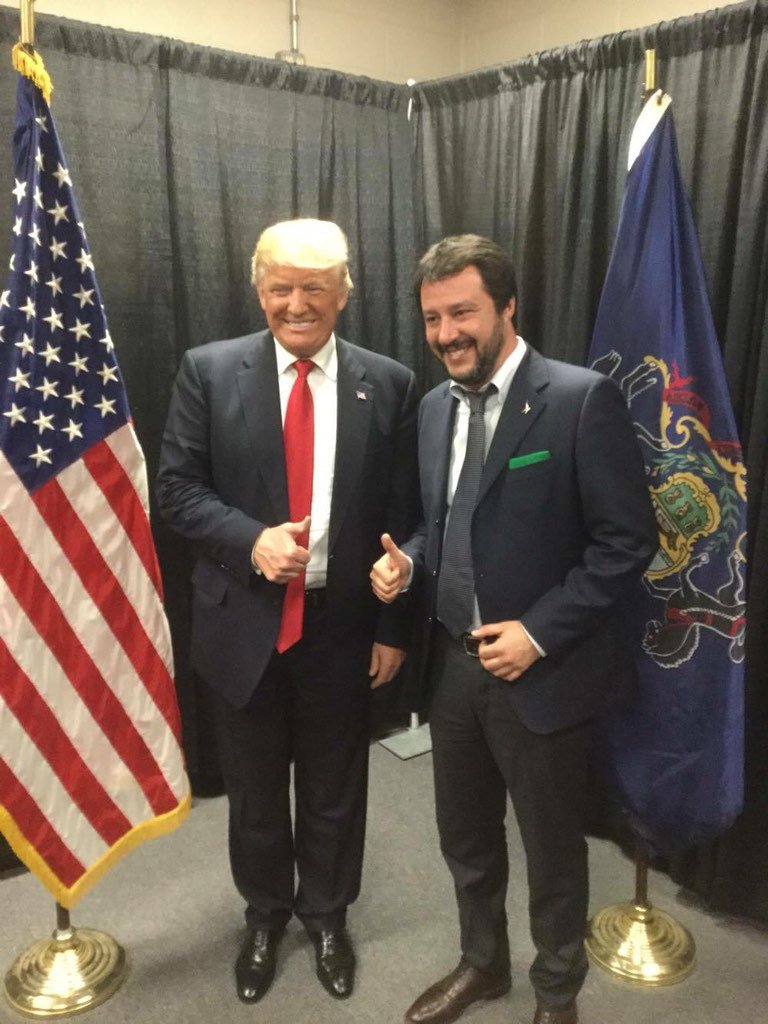
Donald Trump and Matteo Salvini (leader of Italy's racist Lega Nord)


I'm having a hard time thinking of anything positive about this year, a year that has seen nationalists defeat cosmopolitans, bigots outwit the enlightened, and the vulgar triumph over the refined.

Some random, melancholy thoughts in the wake of Brexit, Trump, and now the Italian referendum:

Everything bad about this year is summed up in Matteo Salvini's (leader of Italy's racist Lega Nord) exuberant tweet last weekend after the Italian referendum:

--"Viva Trump, Viva Putin, Viva la Le Pen, Viva La Lega."

There's 2016 in a nutshell. A tweet--in fact a retweet of a tweet he posted immediately after Trump's victory.

I still struggle to accept that our President, the ostensible leader of the Western World, is a fanboy of a Russian thug, an KGB agent no less, owes his wealth to his racist slumlord father, married an illegal immigrant, and proudly boasts about assaulting women--a man who has never read a book, incites violence, makes racist insinuations against our President, has a serious personality disorder, and now---to cap it all--promises to make a fortune out of the Presidency.  Compared to him, even that draft-dodging dimwit George W. Bush was a man of decency, a leader of Periclean abilities.

As I said earlier, Trump, for all his apparent deficiencies, still remains hard to assess, because it is not clear what, if anything he stands for and what he intends to do. I said there were Five Possible Trumps (not mutually exclusive):

(i) Trump the Protectionist;
(ii) Trump the "America-First" Nationalist;
(iii) Trump the White Nativist Xenophobe;
(iv) Trump the Infrastructure-Builder;
(v) Trump the Cypher (the mere frontman for others);

and now a new possibility given the prominent positions of Bannon and Flynn:

(vi) Trump the Neo-Con, the new scourge of ISIS and militant Jihadi Islam.

[Since writing that post, I've come to think that his campaign involved a form of bait and switch.

Trump campaigned as a singular figure, someone beyond GOP dogma--he made noises that sounded democratic--protect workers, have a better health care plan etc.  But now it seems that he has sold his soul to the most reactionary, most white conservative, elements of the GOP. This is an Administration further to the right than Reagan, GWBush and even Ted Cruz. The views of the Cabinet (Price, Sessions etc) do not reflect the average GOP voter still less the country at large.

  Whether abortion should be legal in most or all cases
Price
U.S.
32%
Illegal
64%
Legal
Republicans
60%
35%
Democrats
13%
84%

Effect of illegal immigrants on American jobs
Sessions
U.S.
25%
Take jobs away
65%
Take jobs Americans don’t want
Republicans
46%
48%
Democrats
12%
79%

And yet as soon as I travel down these lines, as soon as I get annoyed at Trump's bait and switch, I realize I'm viewing the world from the perspective of a comfortable liberal.

Would I think the same way if I were a mid-western auto-worker, a white-van driver from the North of England, or some unemployed Italian graduates who can see no hope for employment no matter how distantly he peers into the future?

Perhaps we liberal elites screwed it up. We were too willing to deregulate the economy, ship jobs abroad, open borders to immigrants, even--God help us--launch hubristic foreign wars. We pushed our values and advanced our interests, while dismissing those who resisted as no more than fools and bigots.

If only we had cared more about material equality.  For years, people had been pointing out that western societies were becoming plutocracies.

There's something comforting in believing that greater material equality will fix things. More troubling is the thought that the turn against liberal elites is animated less by material than ideal interests, less a lack of opportunity than a lack of tolerance.

What we are seeing in a lot of Trump and Brexit etc. supporters is a turn towards authoritarian populism. These are people, as someone in the Guardian (where else?) put it: "who could broadly be described as out of step with the cultural assumptions – such as a respect for human rights, immigration, feminism and diversity – that are the bread-and-butter of liberal democracy."

Leaving aside the contentious claim about "the bread and butter of liberal democracy." lets concede that it was the genius of Farage and Trump and Steve Bannon to articulate the worldview of this hitherto belittled rump. (For more on Bannon's worldview, see here.)  Liberals had nothing to say to them. Liberals tend to assume that everyone is reasonable and shares the same basic moral outlook.

That's one of the great shocks of 2016: we occupy modern societies that are deeply-divided on fundamental values. Liberals are now going around saying: "I don't recognize my country."

They should get out more.

I can't forget my encounter with a New York city fireman--off-duty at the time--back in early 2009.  We were sitting next to each other at the bar of an Italian restaurant and got talking. He was incensed by Obama's election. He thought Tim Geithner was a tax criminal who belonged in jail. He was especially bothered by suggestions that poor people caught-up in the sub-prime mortgage crisis might get bailed-out. (Bankers didn't seem to bother him.) He thought that Muslims ("rag-heads," as he predictably called them) were taking over the country. And it would only get worse now Obama was in charge.

When he figured out I was a liberal, he became especially animated. He hated liberals--like everyone else in his Fire House--partly because they preferred an argument to a fistfight. He sneered when he learnt that I didn't follow UFC cage-fighting. He thought everyone should look in a mirror before they voted and "choose one of their own."

I'm almost certain this guy voted for Trump; and I suspect a lot of Trump and Farage and Salvini and Le Pen voters think exactly like him.  Moreover, this is a guy who is not poor.  Firemen earn a ton of money in New York and retire early on fabulous pensions. This guy told me he also owned a plumbing business.

Perhaps we liberals should now give this new order--this form of popular authoritarianism--its chance.  Maybe the popular authoritarians like Trump will do a better job with the economy-- especially if they can escape the cold skeletal hands of austerity--, perhaps they can bring people together in joint hatred of some other "other."

If there is any optimism to be found, surely here is the place to look. Trumps great infrastructure plans will grow the economy--Larry Summer's charge that these plans are a scam will be proven wrong--and the economically disgruntled will all become merely gruntled. The Europeans--the Germans in other words, since they are the only Europeans with agency--will follow suit.  Southern Europe will be lifted on a great tide of fiscal policy. Targeted EU investment will rejuvenate their economies.

And yet...even if this economic renaissance were to appear, I worry that we have more to fear from Trump's success than his failure. For then we will have entered a very different world.   Capitalism, Liberalism, and Democracy will be pulling in conflicting directions. The likely loser here will be liberalism.  The views of that racist New York fireman will gain respectability.

I'm certainly not willing to let that lot take over.  

So what's to be done?

Germany and the Eurozone Crisis


Here are some links:

On German Ordoliberalism; see here and here

Interview with Jens Weidmann, Head of the Buba (2013)

Glyn Morgan, "Greece and the Limits of European Solidarity" (consult the references to Germany in the bibliography)