De Gaulle--Force of Character
https://www.youtube.com/watch?v=17mjfbXWW4g&t=37s
Charles De Gaulle and Six Years Algerian War
https://www.youtube.com/watch?v=ZFl_xU6HCvI
Algerian Revolution (in French)
https://www.youtube.com/watch?v=5rf0POAyw9Q
Jean Monnet
https://www.youtube.com/watch?v=KN27x27LuDs
60 Years of the Schuman Declaration
https://www.youtube.com/watch?v=grDDeqn6GkE
NATO--Origins
https://www.youtube.com/watch?v=Ftr794vPP_A
France 1968
https://www.youtube.com/watch?v=ersgPFN0onQ
Maastricht Treaty
https://www.youtube.com/watch?v=jEKp_hlr8eY
Wednesday, November 16, 2016

Wednesday, November 9, 2016
Europe's Five Trumps

America’s choice last Tuesday signifies a switching of sides from the liberal internationalist camp, to the populist nationalist one. (Frank Fukuyama FT Nov 11)
We have been discussing five or so crises facing Europe. The election of Donald Trump poses another.
Chanceller Merkl has welcomed Trump's election this way:
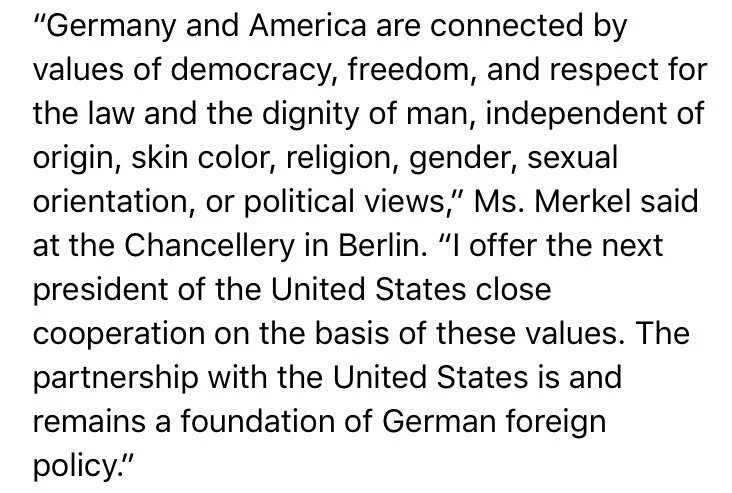
PM Theresa May has welcomed Trump this way:
'Britain and the United States have an enduring and special relationship based on the values of freedom, democracy and enterprise.
'We are, and will remain, strong and close partners on trade, security and defence.
'I look forward to working with President-elect Donald Trump, building on these ties to ensure the security and prosperity of our nations in the years ahead.'

Nigel Farage has been making mischief. He met Trump at the weekend and then announced to the Government that: (a) he would be their best point of access to the President -Elect; and (b) DJT didn't like May and her team for past insults.
The President-Elect has certainly made some controversial moves, including:
(i) Meeting Nigel Farage;
(ii) Appointing the White Supremacist and Anti-Semite Steve Bannon as one of his two main WH deputies; and
(iii) Allowing Bannon to call Marine Le Pen (Head of the Front Nationale) and wish her well--thereby emboldening her and other right-wing parties. (As Gideon Rachman puts it: With Bannon in White House reaching out to Le Pen, Afd etc, the US govt moves from supporting democracy in Europe to actively undermining it.)
Here are some problems this election creates:
1. First and foremost, Trump calls into question the whole basis of the postwar liberal international order.
Gideon Rachman in the FT sums up this concern:
"Mr Trump’s proposed policies threaten to take an axe to the liberal world order that the US has supported and sustained since 1945. In particular, he has challenged two of the main bipartisan principles that underpin America’s approach to the world. The first is support for an open, international trading system. The second is the commitment to the US-led alliances that underpin global security.
Mr Trump is the first avowed protectionist to be elected US president since before the second world war. He has promised to renegotiate America’s “terrible” trade deals, such as the North American Free Trade Agreement and threatened to pull the US out of the World Trade Organisation. He has also threatened tariffs as high as 45 per cent on Chinese goods. If Mr Trump were to follow through on these threats, he would spark a global trade war and could well plunge the world into a recession similar to the depression of the 1930s, which was greatly deepened by America’s adoption of protectionist policies.
Mr Trump’s effect on the global security system could be just as dramatic. The president-elect has questioned whether the US will honour its security commitments to Nato allies and to Japan and South Korea — unless these countries pay more for their own defence. American annoyance at “freeriding” by its allies is a bipartisan concern. What is new is Mr Trump’s overt questioning of the idea that the US will defend its allies from a military attack come what may. This equivocation — combined with Mr Trump’s open admiration for Vladimir Putin, the Russian president — will raise fears that the US will not oppose renewed Russian aggression in Ukraine or eastern Europe."
2. Makes further trade deals next to impossible;
3. Provides further evidence of the appeal of right-wing populism and White nativist nationalism--this could embolden groups/parties in Europe including Marine Le Pen. Similarities between Brexit and Trump's movements (“Take back control”//“Make America great again”)
4. Trump has suggested that NATO's days are numbered--such remarks have created uncertainty about whether Nato will defend the Baltic states.
5. Trump's affection for Putin could lead the Russian leader to create mischief in Eastern Europe--possible destabilization of Estonia.
6. Impact on Iranian Deal
7. Impact on East Asia
8. US/Western "Soft Power"--some of the figures Trump is considering would be anathema to Europe--esp. former Ambassador John Bolton.
9. Trump's character presents difficulties.
Are there any upsides to Europe of a Trump Presidency? Yes, it could possibly push Europe towards unifying--but I wouldn't hold my breath. One likely consequence, there will be a return to the Bush era of a sharp divide between European and American perspectives on the world.
See the following: red--Europeans with a bad opinion of the President; blue--a good opinion.

More specifically, Trump represents for the Europeans uncertainty, or what the Germans call Unsicherheit (which can be translated as both uncertainty and insecurity).
Noone can be confident what Trump the President stands for. Does he even have a consistent position? Does he stand for anything?
Fukuyama thinks that he is a political and economic nationalist.
Trump does have a consistent and thought-through position: he is a nationalist on economic policy, and in relation to the global political system. He has clearly stated that he will seek to renegotiate existing trade agreements such as Nafta and presumably the WTO, and if he doesn’t get what he wants, he is willing to contemplate exiting from them. And he has expressed admiration for “strong” leaders such as Russia’s Putin who nonetheless get results through decisive action. He is correspondingly much less enamoured of traditional US allies such as those in Nato, or Japan and South Korea, whom he has accused of free-riding on American power. This suggests that support for them will also be conditional on a renegotiation of the cost-sharing arrangements now in place.
My view is that we have to think in terms of five possible Trumps and no one knows which one (or more than one, for they are not mutually exclusive) will predominate:
1. Trump as Economic Populist--he launches a big infrastucture plan (although that is easier said than done) and renogotiates trade deals to allow more protection for US workers (again not easy).
2. Trump as Xenophobe;
3. Trump as Isolationist;
4. Trump as Protectionist;
5 Trump as Cypher--a hollow man who will articulate the views of whichever faction in the GOP or Alt-Right that captures him.
Alternatively, there are those that believe that Trump can turn into a pragmatist or, even if he were a xenophobic protectionist, he would be constrained by constitutional norms and the institutional system.
These 5 Trumps have better and worse implications for Europe, but all are rather alarming.
Friday, November 4, 2016
Brexit and the Judges
The latest development in the Brexit mess: the Judges in Britain have decided that the Government cannot trigger Article 50 without first getting parliamentary approval.
Read the decision here.
This perfectly reasonable judicial decision led to hysterical comments from Britain's gutter press (Daily Express, Daily Mail, The Sun etc.)
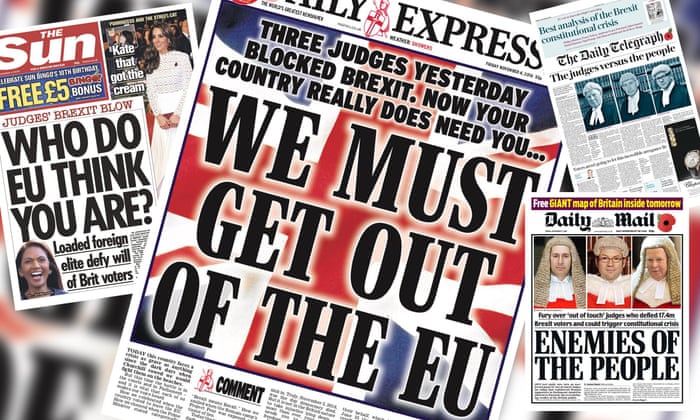
There are some complicated legal issues behind this decision. Such issues include:
(i) whether and to what extent EU Law forms part of UK law and creates rights for UK citizens--rights that only the parliament can abolish;
(ii) whether and to what extent Treaties between states require parliamentary approval.
[ Note: "According to constitutional practice in the United Kingdom, Parliament has no formal role in treaty-making, as the power to do so is vested in the executive, acting on behalf of the Crown. Where a treaty requires a change in UK legislation or the grant of public money, Parliament may vote in the normal way to make or deny the required provision; in other circumstances it can only overcome the will of the executive to conclude a particular treaty by expressing disapproval and relying on political pressure to change the mind of ministers, or, in the extreme case, by withdrawing its confidence from them. The lack of formal parliamentary involvement in treaty-making differentiates the British Parliament from most other national legislatures.]
and (iii) whether the referendum decision was conclusive or merely advisory. [Note: The Referendum Bill made it clear that the referendum was merely advisory.]
The legal rectitude of the Miller decision turns on the impications of the European Communities Act 1972, the act that took Britain into the EEC. Did that act create statutory rights that only Parliament can now take away?
If you are interested in the standing of European law in the UK, see
Thoburn v Sunderland City Council (discussed in my The Idea of a European Superstate)
But these legal issues are small compared to some wider political and philosophical questions involving the authority of popular sovereignty (i.e. decisions reached via direct democracy or a referendum), parliamentary sovereignty (i.e. decisions reached via representative democracy through a legislature) and basic principles of political morality.
From a political perspective, the furious reaction to the judges decision is further evidence of the populist anger against elites and experts, a feature of the political debate in the UK and the US.
Predictably Nigel Farage was on the Sunday morning news shows breathing fire. His position is that the judges have over-ruled the will of the British people. (See the transcripts of his interview on The Andrew Marr Show.)
“We are heading for a half Brexit…. I’m becoming increasingly worried.
“I think we could be at the beginning, with this ruling, of a process where there is a deliberate, wilful attempt by our political class to betray 17.4 million voters.”
Much of the political controversy over Article 50 in the UK proceeds from a genuine anxiety over the bargaining position that May will adopt with respect to the EU.
This anxiety has grown in recent weeks for four reasons:
(I) The Canada-EU trade deal (CETA) ran into difficulty, suggesting that any UK-EU deal will be even trickier;
(II) Various EU leaders have said it's Hard Exit or No Exit;
(III) May apparently (and secretly) promised Nissan that their trading relations with the EU would not change in a negative way:
(IV) The Indians told May that they want easier immigration policies in return for any trade deals the British might want from India.
From a philosophical point of view, the Miller decision raises some fundamental questions about the nature of democracy and sovereignty in a modern liberal society.
1. Who has ultimate authority judges, the executive (i.e. President or the Crown), the parliament (i.e. the legislature), or the people (via direct democracy or referendum)? What happens if the people vote one way and the parliament votes another?
2. What is the responsibility of the individual Parliamentary or Congressional Representative?
Here the lines of Edmund Burke (1774) are worth recalling:
But authoritative instructions; mandates issued, which the member is bound blindly and implicitly to obey, to vote, and to argue for, though contrary to the clearest conviction of his judgment and conscience –these are things utterly unknown to the laws of this land, and which arise from a fundamental mistake of the whole order and tenor of our constitution.
Parliament is not a congress of ambassadors from different and hostile interests; which interests each must maintain, as an agent and advocate, against other agents and advocates; but parliament is a deliberative assembly of one nation, with one interest, that of the whole; where, not local purposes, not local prejudices, ought to guide, but the general good, resulting from the general reason of the whole.
Academics are divided on these issue. (For a range of views, see here and here and here.) Les Green from Oxford University had this to say:
"Today’s judgment in the High Court... (R (Miller) v Secretary of State for Exiting the European Union). Lord Thomas of Cymgiedd CJ, Sir Terence Etherton MR, and Lord Sales decided that the UK executive lacks any power to transmit the will of the people into law by triggering the notification procedure for exit that is outlined in the EU Treaty. The court holds that the absolute sovereignty of Parliament must be respected, and that such prerogative power as the executive has to act in international affairs, including treaties, can never repeal rights in domestic law. So Parliament must still decide whether to leave the EU. The matter remains open.
The breadth of the doctrine is breathtaking. The court does not merely say that Parliament is not, in this case, strictly bound by the referendum result; it declares that any popular vote is of zero legal relevance until Parliament expressly chooses otherwise. It is not even legally persuasive: ‘a referendum on any topic can only be advisory for the lawmakers in Parliament unless very clear language to the contrary is used in the referendum legislation in question.’ [emphasis added]
If the Supreme Court confirms this decision, the entire national debate on the EU can begin over: in the House of Commons, in the (unelected) House of Lords, then possibly back again to the courts, or maybe even the electorate. And that is what the claimants want: delay and time for second thoughts and further lobbying–not on the ground that the referendum result was unclear or the procedure unfair, but on the ground that the question was wrongly decided."
Les Green puts it nicely:
Les Green puts it nicely:
"Democracy is government by the people. But the definition of ‘the people’ is not a matter solely for Parliament. It is matter prior to parliamentary democracy, and the legitimacy of Parliament depends on settling it correctly. The people have a right to decide for themselves the most basic terms of their constitution, including the people who will empowered by that constitution. That is why it is for Scots to decide whether to remain in the UK—and not for the UK as a whole; and why it is for the British to decide whether to remain in the EU—and not for the other member states (my emphasis added).
......The UK has a fluid, informal constitution, and when disputes about its basic ground rules reach our courts, they generally lie in a penumbral zone where, whatever judges pretend, their decisions not only have political consequences but are made, and can only be properly made, on grounds of political morality. There are no ‘purely legal’ decisions at this level.
........Popular sovereignty is a moral ideal. Parliamentary sovereignty is an institutional device, helpful where it secures important values, but a hindrance when it does not."
My quick view on this is that:
Judged against any plausible standard of political morality, it is difficult to sustain the claim that "a people" has the right to constitute itself as such regardless of the impact of its decision on others. Decisions about exit (whether withdrawal from the EU or secession from a state) can have catastrophic effects on those excluded by the new definition of "a people." I don't think that it should be only up to the Scots to decide whether to remain in the UK. I think that any legitimate Scottish secession ought to require concurrent majorities at three different levels--Scotland, UK, and Europe. Likewise. I think any British withdrawal ought to require concurrent majorities at the sub-national levels (esp. Northern Ireland), UK level, and the European Parliamentary level.
As a matter of political morality, the UK referendum decision ought to have been made conditional on its acceptability to others in Europe who face the loss or curtailment of their Union Citizenship. In my view, the Judges didn't go far enough. Neither popular sovereignty nor parliamentary sovereignty are fundamental moral ideals. The decisions that emerge from them warrant support only insofar as they accord with fundamental principles of political morality.
Wednesday, November 2, 2016

Security, Terrorism, and Free Speech

The topic of civic integration is now linked closely in the European public's mind with threats to security.
This issue raises a bunch of sociological and philosophical questions.
Broadly stated, people who worry about the security threats have in mind two different concerns:
(a) Street crime--robberies rapes. (See the kerfuffle over the Cologne New Year festivities);
(b) Terrorism--Paris attacks etc.
Yet we might also include the threat to core European values such as freedom of speech, secularism, and religious disrespect. These issues have cropped up over the Danish Cartoons and the French satirical magazine Charlie Hebdo.
From a sociological point of view, we want to know:
(i) what leads people to resort to terroristic violence against their state?
(ii) are such people driven by any specific ideology?
(iii) are they people that share a particular social or psychological background?
READ AND WATCH THE FOLLOWING:
Rana Foorohar, Why Europe Needs More Integration to Fight Terror—and All Its Other Problems Time 2015 (OP-ED)
That Ignoramus--The Roy-Kepel Debate NYT
Islam in France/Making of a Martyr (BBC Documentary 1997)
The Jihadist Next Door (You Tube - Channel Four UK)
French Terrorism Act (projet de loi renforçant les dispositions relatives à la lutte contre le terrorisme)
Olivier Le Bot, Striking a balance: from hate speech to glorification of terrorism - freedom of speech post-Charlie Hebdo
Simon Jeffrey, Q&A: the glorification of terrorism The Guardian 2006
Glyn Morgan, Mill's Liberalism, Security and Group Defamation
Monday, October 31, 2016
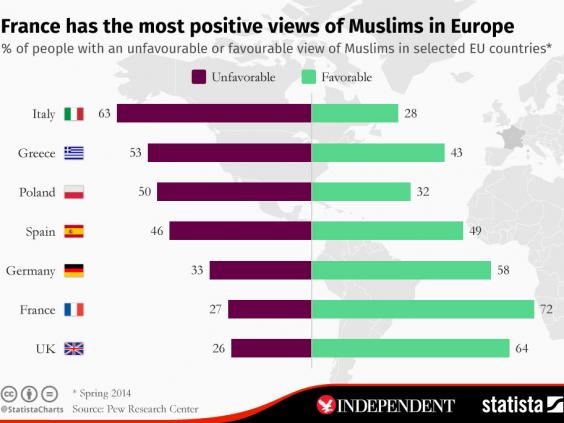
Europe. Multiculturalism and Civic Integration
England 1966
England v West Germany 1966

England 2016

England Women's Football Team 2016

Germany 2014

France 2016

Italy 2016

England Football Fans World Cup 1966--note Union Jack (symbol of the United Kingdom)

England Football Fans World Cup 2016--note the flag of St George's Cross (symbol of the English nation).



READINGS, DOCUMENTARIES AND LECTURES:
Steven Schulman, Challenging the Civic/Ethnic Divide in the Study of Nationalism
Christian Joppke, Immigrants and Civic Integration in Europe
Jacques Barou, Integration of Immigrants in France: An Historical Perspective
Wright Thompson. When the Beautiful Game Turns Ugly--Racism in Italian Soccer ESPN
Karin Showalter, Multiculturalism and Immigrant Integration: Political Debates and Social Realities in Europe (Lecture and Powerpoints)
Islam in France/Making of a Martyr (BBC Documentary 1997)
That Ignoramus--The Roy-Kepel Debate NYT
Conversations with History--Olivier Roy
Sunday, October 23, 2016
Brexit--Dirty, Brutal, and Hard
There have been lots of new developments in the BREXIT saga since we discussed it in class.
A debate still rages over--"No Exit;" "Soft Exit;" "Hard Exit"--and two new ones I saw today "Brutal Brexit." and "Dirty Brexit"
A debate still rages over--"No Exit;" "Soft Exit;" "Hard Exit"--and two new ones I saw today "Brutal Brexit." and "Dirty Brexit"
" EU leaders set up a Brexit task force chaired by Didier Seeuws, a Belgian diplomat, to prepare the legal framework for Britain’s EU exit. One of the scenarios his team are working on is a “brutal Brexit” — an non-amicable separation under WTO rules." (See article from London Sunday Times here and check out the table blow to see what WTO rules imply.)
Many still are holding out hope for a compromise deal, which would avoid Hard Exit. As Gideon Rachman FT put it:
I'm on record that some form of Hard Exit is the most likely--both because it makes sense for the EU (to discourage others) and for Theresa May personally (to protect herself from the right-wingers like the odious Gove).
Hard Exit makes little sense, however, for Britain economically.
From a normative point of view, I think the EU should inflict "Brutal Brexit" to discourage an anti-EU populist contagion (see my article in the preceding blog post).
Theresa May's position on Brexit remains very uncertain, not least because she has said a number of contradictory things. Her speech to the Conservative Party conference was very nationalistic and suggested "Hard Brexit" was inevitable. Clearly, there are those in the cabinet--Philip Hammond especially (see here too)--who fear that HB will prove very bad for the economy. To complicate matters further, there is strong opposition to HB from the Welsh Scottish and Northern Irish First Ministers.
Any form of "Hard Brexit" will also prove very bad news for Ireland; and the news only got worse for the Irish today when the Sunday Times reported that the British would retaliate against the EU by slashing its corporation tax rates--thereby hitting at one of Ireland's core national economic policies.
For an interesting article on he current situation from an Irish perspective, see this article by Fintan O'Toole from The Irish Times
At the moment, the British economy is doing well out of the fall in sterling (1.50 ish --> 1.20 ish agsinst the USD; and 130ish to 110ish against the Euro) ).
There remain, however, fears about the impact this fall will have on inflation in the upcoming years. (See this article from AEP.) Apple has already jacked up the price of Mac computers in Britain. Furthermore, Britain faces a large current account deficit. (For more on how the current account or balance of payments is calculated, see here.)

Many still are holding out hope for a compromise deal, which would avoid Hard Exit. As Gideon Rachman FT put it:
The central compromise has to be around the question of free movement of people. Both sides should move away from their absolutist positions. The British must accept that they cannot “take back control” of immigration fully — and get the access to the single market that is crucial to the UK economy. The EU side should accept that the principle of free movement of people can be intelligently modified — giving the UK some assurance that there can be an upper limit to immigration, while still retaining open labour markets.
The way to achieve this goal is to establish the principle of an “emergency brake” on immigration. In normal times, free movement of people would operate as it does currently. But if there were large surges of immigration into the UK above a preset limit — or any EU member state — the country involved would be allowed to limit numbers. Such a deal offers advantages to Europe, as well as the UK. It would prevent a damaging trade war. It would also mean that, in normal times, EU citizens would continue to enjoy the opportunity to work in the UK.
Hard Exit makes little sense, however, for Britain economically.
From a normative point of view, I think the EU should inflict "Brutal Brexit" to discourage an anti-EU populist contagion (see my article in the preceding blog post).
Theresa May's position on Brexit remains very uncertain, not least because she has said a number of contradictory things. Her speech to the Conservative Party conference was very nationalistic and suggested "Hard Brexit" was inevitable. Clearly, there are those in the cabinet--Philip Hammond especially (see here too)--who fear that HB will prove very bad for the economy. To complicate matters further, there is strong opposition to HB from the Welsh Scottish and Northern Irish First Ministers.
Any form of "Hard Brexit" will also prove very bad news for Ireland; and the news only got worse for the Irish today when the Sunday Times reported that the British would retaliate against the EU by slashing its corporation tax rates--thereby hitting at one of Ireland's core national economic policies.
For an interesting article on he current situation from an Irish perspective, see this article by Fintan O'Toole from The Irish Times
BREXIT Impact on British Economy
Currency--GBPUSD

Currency--GBPUSD
At the moment, the British economy is doing well out of the fall in sterling (1.50 ish --> 1.20 ish agsinst the USD; and 130ish to 110ish against the Euro) ).
There remain, however, fears about the impact this fall will have on inflation in the upcoming years. (See this article from AEP.) Apple has already jacked up the price of Mac computers in Britain. Furthermore, Britain faces a large current account deficit. (For more on how the current account or balance of payments is calculated, see here.)
Some new pieces worth reading:
NYT OP ED--the EU should stick to its guns on Brexit
Brits prefer tight borders over single market access: poll
Ben Chu, "Five Realistic Brexit Options"
Jonathon Freedland, "We're marching towards extreme Brexit" Guardian
John Lanchester, Brexit Blues, LRB
"For Britain Quitting the Single Market may be a Tough Sell," NYT
Jonathon Freedland, "We're marching towards extreme Brexit" Guardian
John Lanchester, Brexit Blues, LRB
"For Britain Quitting the Single Market may be a Tough Sell," NYT
Simon Head, The Death of British Business NYRB
Ewan Gibbs and Rory Scunthorpe, "Mayism and the Economics of Nationalism," The Sceptical Scot
Daniel Korski, Why Remain Lost--article by someone involved in Cameron's campaign.
EU perspectives on Brexit--a bunch of European economists
EU perspectives on Brexit--a bunch of European economists
Banking Boss Says Firms Preparing to Leave UK Before EU Exit (h/t Thomas M.)

There is lots of speculation about banks leaving. Where will they go? See here From which the following table is taken):

Subscribe to:
Posts (Atom)