Friday, October 21, 2016

Freedom of movement under attack: Is it worth defending as the core of EU citizenship? 

"Union citizenship for UK citizens"

Glyn Morgan


Union Citizenship for UK Citizens
By Glyn Morgan (Maxwell School, Syracuse University)

In the wake of the Brexit vote, Floris de Witte’s defense of citizenship-based freedom of movement is as important as it is timely. In linking movement to citizenship, as de Witte notices, those who move have a secure status in their new country. In any member state, the new arrival is not a foreigner, not a guest, not someone who has to apologize for being there, but a citizen whose rights are guaranteed by the EU. No one can say: “you don’t belong here.” And if they did; the response would be: “I have the same rights as you to live and work anywhere in the EU.”
Now with Brexit, UK Citizens will lose freedom of movement, and Europeans resident in Britain will lose the protection afforded by Union Citizenship. More worrying still, Brexit threatens to unravel the postwar achievements of European integration. If the UK prospers in the immediate aftermath of Brexit, other countries might follow. A Europe of nation-states will be the outcome. The idea of a unified European polity powerful enough to defend itself and project its values abroad will be lost. 
The EU must act to ensure that Brexit is a failure. It can do this by crafty deployment of a carrot and stick strategy. The stick should come in the form of refusing the UK any privileged access to the Single Market without accepting freedom of movement. No “passporting” for the UK financial services industry—a key component of the British economy—should be allowed. US and other foreign banks should be forced to relocate their headquarters to an EU financial center. The EU should make crafty use of non-trade barriers to hinder the exports of British manufacturers. If the UK wants out of the Customs Union, then the EU should monitor in fine-grained detail, a slow and cumbersome process, the foreign component of UK exports. British visitors to the Continent should be required to attain expensive visas.  More here

Wednesday, October 19, 2016

Europe's Immigration Crisis

Immigration


http://migrantreport.org/arrivals-by-sea-approach-250000/


In contrast to the Eurozone Crisis, the most interesting questions prompted by Europe's immigration crisis are less to do with economics than ethical or philosophical in nature.


 Consider these:

1. What do people in wealthy countries owe people in poor countries?

2. Why treat "refugees" differently from "economic migrants?"

3. Is there a justification for "closed borders"? If so, what is this justification?

4. Do EU member states owe more to fellow "Europeans" than "non-Europeans?"

5.  Do states owe more to people from countries that they have have harmed?

6. Should illegal immigrants be deported?


Philosophical articles to read:

--Phillip Cole, "On the Borders of Solidarity"--pro-open borders

--When Immigrants Lose their Human Rights--Interview with Joe Carens (pro-open borders)

   The three most influential anti-open borders scholars are: Paul Collier, David Miller, and David Goodhart


David Goodhart, Too Diverse?

And on the question whether states owe more to people from countries that they have have harmed, see:

 James Souter. "Towards a Theory of Asylum as Reparation for Past Injustice"

For more on these topics, see the book Sarah Fine and Lea Ypi, Migration in Political Theory

Image result for europe immigration crisis

migrants routes to europe


Immigrants, 2014 (per 1 000 inhabitants)

File:Immigrants, 2014 (per 1 000 inhabitants) YB16.png


Image result for source of migrants europe 2014


News Stories, Articles, and Documentaries

"The flow of Africans from Libya to Italy is now Europe’s worst migration crisis." Economist Oct 2016

 Europe's Immigration Crisis is Just Beginning (Washington Post 2016)

Bruce Stokes, The Immigration Crisis Is Tearing Europe Apart, FP July 2016

Pierre Vimont, Migration in Europe: Bridging the Solidarity Gap


Alex Norrington, Migrant Report 2014-2015--Med Crisis 2015

"The Making of Merkel's Decision to Accept Refugees" Der Spiegel 24 August 2016

How Politics is Failing the Refugee Crisis (Bild, Germany)

Blessing U. Mberu and Roland Pongou, "Nigeria--Multiple Forms of Mobility in Africa's Demographic Giant," Migration Policy Institute

Caitlin Katsiaficas, Asylum Seeker and Migration Flows in the Med

Guiliani, The Challenge of Illegal Immigration in the Mediterranean

OPINION:

Opinion: Roberto Savio, Immigration, Myths and the Irresponsibility of Europe


DOCUMENTARIES:

The Truth About Immigration (BBC Documentary 2014)

African Migrants Trying to Reach Europe (Channel Four--Newsclip)


Wednesday, October 12, 2016

The Eurozone Crisis--Ireland (Part Five)


IRELAND


Map of Ireland


In many ways, Ireland looks like a bog-standard property bubble and bank crisis--not much different from Japan in the 1980s/1990s, Florida 2000s, Iceland 2008 and even UK (Northern Rock/RBS) 2007-8. 

I still remain unclear about four points:

 (i) How did Ireland get wealthy so quickly? By 2006, Ireland was one of the wealthiest countries in the world. Looking at Ireland across the Irish Sea from Wales, we Welsh were all gobsmacked. A bunch of people who we had always thought of as our poorer Celtic cousins were suddenly swimming in gravy. 

(ii) To what extent was the EMU and/or the ECB culpable in the bubble and bank crash?  To pose a counterfactual--If Ireland had been outside of the EMU like Britain, would the bubble and crash have happened?

(iii) To what extent was the Troika culpable for the terms of the November 2010 Bailout?

(iv) How has Ireland (if indeed it has) managed to bounce back faster than Greece, Portugal and Spain? How well has Ireland done in comparison to countries outside the EMU like Iceland and the UK?


Introduction

Watch the following documentaries and read the article by Michael Lewis, a great re-telling of the Irish boom and bust: When Irish Eyes Are Crying

For other popular treatments of the bubble and bust, see the books by David McWilliams--one of the few economists (along with Morgan Kelly) to predict the crises--Follow the Money--available cheaply on Kindle.

For a short documentary introducing the problems of Ireland (from 2011), see:

Ireland Property--Boom and Bust 

RTÉ Ireland How We Blew The Boom here  (Takeaway message: "We must all take responsibility for the choices we made") 


Both Ireland and Spain experienced a huge property boom and then slump. The slump crashed the banks in Ireland and--to a lesser extent--in Spain too.

See this prescient quote by Wolfgang Munchau from March 18 2007--before the crash:

"In Ireland, the GDP share of construction and housing is even higher [than Spain where  the construction and housing sector accounts for 18.5 per cent of gross domestic product, about twice as high as the eurozone average], at 20.7 per cent. While the performance of the Irish economy during the past few decades was remarkable, there are some deep underlying structural problems that are now surfacing. In particular, Ireland has been fast losing competitiveness within the eurozone – not a subject that has been talked about much outside Ireland recently. With interest rates rising and a slow return to sanity in the financial sector Ireland is going down the same route as Spain, perhaps only faster."


Questions to keep in mind:

1. Ireland was the first Eurozone country to experience a banking crisis. Why?


2.  To what extent was Ireland's membership of the EZ a cause of the 2008 crash?


3.  How has Ireland's post crash experience differed from that of Greece and Spain? What explains the differences?


4. Has Ireland recovered? Did "austerity" work?


5. What impact will Brexit have on Ireland?


Let's begin with some charts:


Demographically, Ireland is much "younger" than many other European countries. Compare the Population Pyramids of Ireland with those of Italy and Spain.


Image result for ireland population pyramid

Image result for italy population pyramid 2010

sp-2010.png


Spain and Ireland--Government Budget:


Spain Government Budget

Ireland Government Budget


Spain and Ireland--Current Accounts

Spain Current Account to GDP

Ireland:


Ireland Current Account to GDP


Germany Current Account to GDP


Spain and Ireland Sovereign Debt

Spain Government Debt to GDP


Ireland Government Debt to GDP

Spain and Ireland Unemployment

Spain Unemployment Rate


Ireland Unemployment Rate

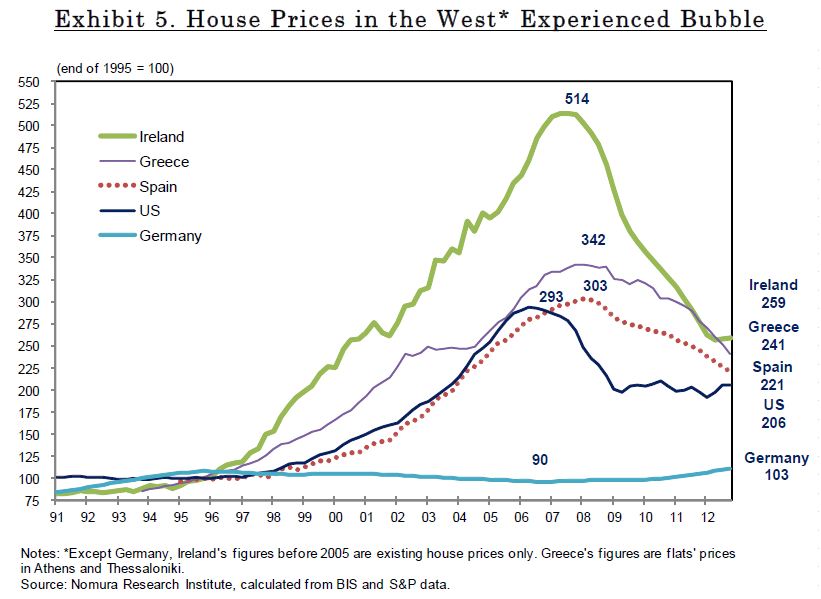
Spain and Ireland House Inflation--compare to Germany

--consider the difficulties this graph presents for a Central Bank seeking to implement an effective counter-cyclical policy.


Ireland was in a world of its own:


Image result for ireland economic growth history

Image result for eurozone interest rates


Ireland as Celtic Tiger


Ireland experienced a staggering rate of economic growth and employment creation during the 1990s, which exceeded the rest of Europe and other advanced industrial countries (the OECD). See this primer from the Wall Street Journal.


Ireland Corporate Tax Rate:


Image result for corporate tax rates oecd


Ireland Taxes as Percentage of GDP


Chart 6.6: Estimated contribution of capital, labour and consumption taxesto total tax burden — OECD 2005(a)


Ireland Economic Growth:


Ireland from Emigrants to Immigrants:


There are some useful details and analysis on recent Irish migration patterns from Constantin Gurdgiev's True Economics blog here:


This economic success quickly gave rise to the idea that Ireland was a "Celtic Tiger"--reference to the fast growing East Asian Tigers  of the 1970s and 1980s.  For a typically hyperbolic expression of this point of view, see the NYT's columnist Thomas Friedman, "Following the Leaping Leprechaun,"--an article (amplified in his book The World is Flat) that invited a later scornful response "Just How Wrong Can the NYT's Tom Friedman Be?"

For a scholarly take on Ireland 1990s experience, see Niamh Hardiman, "Politics and Markets in the Irish “Celtic Tiger” Experience: Choice, Chance, or Coincidence?"

Frank Barry, The Globalized Irish Economy in Good Times and in Bad" (a more advanced discussion)

Derry O'Brien, "Measuring Ireland's Price and Labour Cost Competitiveness." (a more detailed and advanced discussion)


Ireland Property Bubble

The Timeline of the Irish Crisis:

For a great re-telling of the Irish boom and bust, read Michael Lewis, When Irish Eyes Are Crying

For a good discussion of the causes of the bubble, see Morgan Kelly (2009):

Quoting Morgan Kelly:

"--Ireland is unusual because its entire economy after 2000 came to be driven by a property bubble.

--By 2006 construction accounted for 20% of GNP, banks had dangerous exposures to building and commercial property loans, and domestic wages had been driven to uncompetitive levels.

--During the 1990s Ireland experienced the Celtic Tiger: rapid employment growth driven by competitive labour costs.

--As employment and income rose, house prices were driven up.

--Construction rose and this increased employment, leading to further construction: multiplier accelerator.

--As property prices rose, value of collateral increased and perceived risk of property lending fell: fi nancial accelerator.

--Effect of bank lending exacerbated by narrowness of Irish market: by increasing lending by 20% a handful of banks could drive up property prices by 20%: elements of pyramid scheme.


--Market came to be driven by expectations of capital gains: rental yields below 4%"


November 2010 Troika Bailout 

After Months of Resisting Ireland Applies for a Bailout NYT Nov 21 2010

Philippe Legrain's articles on the Irish bailout are well-worth reading as is his book European Spring

See Fintan O'Toole's piece:

"The imposition of €64 billion of private banking debt on Irish citizens has been so thoroughly normalised that those of us who find it shocking begin to wonder if perhaps it is we who are mad. We need sane outside voices to remind us, every so often, that yes – it really is an outrage. The latest is Philippe Legrain who until earlier this year was head of the team of strategic policy advisers to the president of the European Commission, José Manuel Barroso. In his fine new book, European Spring, Legrain helpfully reminds us of the nature of the game: “had Irish banks defaulted on all their debt at the end of September 2010, German banks would have lost €42.5 billion, British ones €27.5 billion and French ones €12.3 billion.”

.


After the Bank Crisis


Other important scholarly essays looking back at the Irish boom and bust:


John Fitzgerald, "Ireland's Recovery from Crisis"

Karl Whelan, "Ireland’s Economic CrisisThe Good, the Bad and the Ugly"

Barry Eichengreen, "The Irish Crisis and the EU from a Distance"

THE IRISH CRISIS IN COMPARATIVE PERSPECTIVE

For a comparison of the Iceland and Ireland situations, see

 Baldur Thorhallsson and Peadar Kirby, "Financial Crises in Iceland and Ireland: Does EU and Euro Membership matter?"  here

Thor Gylfason, "Iceland's Seven Meagre Years"

Paul Krugman, "Iceland, Ireland, and Devaluation Denial" which includes this useful graph:


Martin Sandbu, "Devaluation's Deceptive Draw" FT (argument: it wasn't devaluation that explains Iceland's better employment performance but a looser monetary policy.)


Sebestian Dellepiane and Niamh Hardimon,  "European Economic Crisis: Ireland in Comparative Perspective"

Henry Farrell blogs about the above piece on Crooked Timber here--some of the comments are helpful too.

Sebestian Dellepiane and Niamh Hardimon, The Politics of Fiscal Effort in Spain and Ireland

Sebestian Dellepiane and Niamh Hardimon, Governing the Economy: A Triple Crisis

Newspaper articles:

Colm McCarthy, "Bank Inquiry fails to shed light on shortcomings of individual lenders"


For the Irish Parliament (Oireachtas) Inquiry into the Banking Failure (January 2016), see here

Role of the media in property boom, a newsclip from the Parliamentary Inquiry

Dermot Gleeson – Former Chairman, Allied Irish Bank at the Banking Inquiry

Banking Inquiry - Joe Higgins Questions Dermot Gleeson Former Chairman of AIB

David McWilliams on what should have been done on Sept 30 2008

I think it is a good idea to think here too about the Royal Bank of Scotland. See the book and the documentary:


Impact of Brexit on Ireland


"Ireland may have to Consider Leaving the Euro" 

"Irish Leaders Fear Brexit Will Bring Economic Disaster"

"Ireland Beyond Brexit"--a useful collection of articles from the Irish Times


These lectures are also well-worth watching if you are interested in the Ireland chapter of the Eurozone Crisis:

Morgan Kelly, Whatever Happened to Ireland (2014)

Peter Mair, How Parties Govern (2013)

Christine Lagarde, Ireland Bailout Compared to Greece (2015)

Ireland's 26 PerCent Growth Leaves Economists Speechless

There are some very interesting documentaries about the 2008-2009 Bank Collapse in Ireland--esp. the failure of the Cowen Govt. and the Nationalization of the Anglo-Irish Bank.


Crisis Inside the Cowen Government (Part One)

Crisis Inside the Cowen Government (Part Two)

Bertie Ahern Documentary

Bertie Ahern==Mahon Report

Freefall--The Collapse of Irish Banks


Monday, October 10, 2016

The Eurozone Crisis--GREECE--Annnotated Bibliography (PART THREE)

The Eurozone Crisis--GREECE--Annotated Bibliography (PART THREE)

Watch the documentaries mentioned earlier.

Timelines of the Greek Crisis can be found here and here and here.

Background:

The Requirements of the European Monetary Union Growth and Stability Pact:

1. Government deficit  less than 3% of GDP
2. Sovereign debt less than 60% of GDP
3.  If more than 60% it should decline each subsequent year at a satisfactory pace.

Greece's Difficulty in Meeting these Requirements

The Greek story can be summed up by following the story presented in graphs; see here:

The key event, mentioned earlier, was the announcement by the incoming Greek PM Papandreou in October 2009 that Greece's deficits were much higher than earlier announced.

Greece Deficit


Greek Debt:


The German and Greek 10 Year Bonds 1993-2015 (remember Greece entered the EU 1986):


Unit Labour Costs:


Broadly stated, there are five different (non-mutually exclusive) positions on the Greek chapter of the EZ Crisis:

1. The EMU is structurally flawed. (De Grauwe; Krugman)

2.  The Troika (EU/ECB/IMF) mismanaged the crisis--they chose to bailout Northern European Banks in 2010 rather than let Greece Default. (Sandbu--who thinks that there is nothing structurally wrong with EMU; and Eichengreen, Krugman, and Stiglitz--who thinks that there is).

3.  It's all the fault of the Germans (Simon Wren Lewis and John Weeks and Adam Posen and Peter Bofinger--for a more developed discussion of this topic, see Servaas Storm, "German Wage Moderation and the Eurozone Crisis: A Critical Analysis");

4.  It's substantially the fault of Greek politicians and policy-makers (German economists who hold this view include Jens Weidmann [Head of the Bundesbank], Hans Werner Sinn, and in a more nuanced version, the Greek Political Scientist Stathis Kalyvas);

Storm (a critic) summarizes this view as follows:

 In this narrative, rising unit labor costs are due to fiscal profligacy and “rigid” “over-regulated” labor markets, powerful unions, and strong employment protection. Rising relative unit labor costs supposedly killed Southern Europe’s export growth, raised current account deficits, created unsustainable external debts and reduced fiscal policy space, and hence, when the crisis broke, these countries lacked the resilience to absorb the shock. It follows in this story that the only escape from recession is for the Southern European countries rebuild their cost competitiveness—cutting wage costs (because Eurozone members cannot devalue their currency) by as much as 30% (as proposed by Sinn 2014), which requires in turn that their labor markets be thoroughly deregulated.

5.  It's a consequence of Greece's unfortunate history, but in no way the fault of contemporary Greeks.

My view, for what it is worth, is some combination of 1. and 4. and 5.


The 2010 Greek Bailout

Greece Accepts Bailout Package
From CNN May 2 2010

 Greece has accepted a bailout deal including tough austerity measures, Finance Minister George Papaconstantinou announced Sunday.


The international aid package, negotiated with the European Central Bank, European Commission and the International Monetary Fund, will be worth 110 billion euros (US $146 billion) over three years, Eurogroup President Jean-Claude Juncker said in announcing the agreement Sunday evening from Brussels, Belgium.
Of the overall amount, 80 billion euros will be made available through euro-area members, with up to 30 billion available in the first year, Juncker said.
The first disbursement of bailout money will be made before May 19, Juncker said.
The program will "help restore confidence and safeguard financial stability in the Euro area," Juncker said in praising the deal.
The package includes a promise by Greece to cut its budget deficit to 3 percent of gross domestic product, as required by European Union rules, by 2014, according to Papaconstantinou.
Greece had a choice between "destruction" and saving the country, and "we have chosen of course to save the country," Papaconstantinou said.
Olli Rehn, the commissioner of Eurogroup, said that "the steps being taken, while difficult, are necessary to restore confidence in the Greek economy and to secure a better future for the Greek people."
The head of the European Commission Sunday praised the Greek government for committing to "a difficult but necessary reform process."
The program "constitutes a solid and credible package," Commission President Jose Manuel Barroso said in a statement.
The planned austerity measures are unpopular among Greeks. Protesters clashed with police Saturday during May Day demonstrations, and strikes have been announced for later this week.
Papaconstantinou confirmed Sunday that the government would tighten its belt significantly, despite the protests.
"The expenses of the public sector will go down very considerably," he said.
The program includes cuts in the salaries of public-sector workers, including lawmakers, higher taxes on cigarettes, fuel, gambling and luxuries, an increase in the value-added tax consumers pay on purchases, and an increase in the retirement age for women in the public sector, Papaconstantinou said.
Prime Minister George Papandreou earlier Sunday tried to rally the country behind the government.
"I know that our compatriots are being asked to make big sacrifices, but the alternative way would be disastrous and painful for us," he said in a televised Cabinet meeting.
"It's not a pleasant decision for me, for any of us, but we are here to make the right decisions for our country," he insisted.
He spoke a day after Greek protesters clashed with police who fired tear gas during the annual May Day rally in Athens.
Waving red flags, the crowd at times surged toward the line of police, who wore helmets and carried riot shields. The police pushed them back each time.
Protesters threw objects toward police, and scattered fires were burning on the streets.
Seven police officers were injured, police said. Nine people were arrested -- three for attacks on police and six for theft from stores.
Twenty-seven people were questioned in connection with violence. A van belonging to state broadcaster ERT was set on fire.
About 12,000 people were protesting in Athens, and rallies were also taking place in the northern city of Thessaloniki, a police spokesman said.
Protesters there smashed two ATMs, the glass frontage of a bank, and a car, but no one was arrested or being questioned, the spokesman said.
The Greek government is facing a large deficit and massive debt, ultimately threatening the stability of the euro. The currency is used by 16 countries across Europe, including Greece.
Greece's national debt of 300 billion euros ($394 billion) is bigger than the country's economy, and some estimates predict it will reach 120 percent of gross domestic product in 2010.
Options available to EU in 2010:
1. Bailout Greece and Impose Austerity and require Structural Reform (the policy adopted). [Note much of the money loaned to Greece was used by Greece to pay off its debts to Northern European banks and other Eurozone Countries).
2. Bailout out as above but with much less austerity.
3.  Let Greece default within the EMU and use the money to bailout Northern European and Greek banks.
4, Encourage or force Greece out of the EMU-- use the money to bailout Northern European and Greek banks.

The bailout of 2010 did not work and further bailouts in 2012 (130 billion euros) and 2015 (86 billion euros) were necessary. It is likely that another bailout will be needed in a few years.

greek debt crisis

The 2012 Greek Crisis

Key Events:

November 11 Papandreou Resigns

Interim Govt. Nov 11-May 2012 under Loukas Papademou (MIT educated economist)

Feb 2012 Restructuring of Greek Debt (206Bn Sovereign debt)--haircuts to private sector

Feb 2012 Second Greek Bailout (185 Billion Loan package)

May Election --Coalition Govt. New Democracy/PASOK--Syriza wins seats.

Default fears arise in Southern Europe

July 2012--Mario Draghi (Head of ECB) "We will do whatever it takes."

--Mario Draghi introduces Outright Monetary Transaction (OMT) program that agrees to buy sovereign bonds on the secondary market. For assessments, see here and here.

"OMT is the program put in place by the ECB following Mario Draghi’s vow in the summer of 2012 that the ECB was “ready to do whatever it takes to preserve the euro.”  Under this program, the ECB can buy government bonds of a euro area member state in the secondary market, keeping the primary market for these bonds open and driving down the bond yields (Whelan)."

OMT presupposes signing up to European Stability Mechanism (ESM)--i.e. conditionality.

ESM--a bailout set up Sept 2012--all EMU countries to contribute.


GREECE IN COMPARATIVE PERSPECTIVE

Margarita Katsimi and Gylfi Zoega, Greece and Ireland IMF Programmes Compared VOX


Wednesday, October 5, 2016

European Monetary Union --the Euro Annotated Bibliography (Part One)


For a simple background to the creation of the European Monetary Union, see this. The Timeline to the creation is here. For a celebratory documentary on the Euro’s Ten Year Birthday, see this.


The Werner Report 1970 (initially discussed at the Hague 1969) represented the first proposal to set up a Monetary Union between the then 6 member states.  A contemporaneous article notices the federalist implications of the plan:

The Werner Committee's plan for economic and monetary union in the Common Market covers 31 pages. Its fundamental objective is "that the principal economic decisions affecting the EEC will be taken at community level, and that the necessary powers will be transferred to the community [i.e. will be transferred to the supranational level of government]."
The report envisages that by 1980 the Community would formulate budgets, tax policies, and monetary policies; and that there would be a uniform tax system throughout the Community.
It recognises that the transfer of these responsibilities to the Community has "a fundamental political significance and implies the progressive development of political union. The economic and monetary union, therefore, has to be seen as a generator for the development of a political union."
The document says that those must understand its objectives who subscribe to the project, and accept them without equivocation: "Political and monetary unification is an irreversible process and it is essential to go into it with a firm will to achieve it and to accept all its political as well as economic implications."


The Werner Report was shelved, mainly because of a series of global economic crises of the 1970s, including:

--the monetary crisis in 1971 (non-convertibility of the US dollar);
-- the first oil crisis in 1973;
-- the iron and steel crisis in 1974;
 --the economic crisis in 1975;
 --and the second oil crisis in 1979.

1979-1991 European Monetary System (EMS)

"The European Monetary System (EMS) was built on the concept of stable but adjustable exchange rates defined in relation to the newly created European Currency Unit (ECU) – a basket currency based on a weighted average of EMS currencies . Within the EMS, currency fluctuations were controlled through the exchange rate mechanism (ERM) and kept within ±2 .25% of the central rates, with the exception of the lira, which was allowed to fluctuate by ±6% ."

A new plan took shape in 1988 and was published as the Delors Report in 1989.

The idea of a European Monetary Union faced intellectual and political obstacles.

The intellectual obstacles came from economists, who in the 1960s and 1970s had formulated a theory of an Optimum Currency Area (OCA). For a useful summary of this theory, read pages 1-6 of Francesco Paolo Mongelli, “European Economic and Monetary Integration, and the Optimum Currency Area Theory.’’

Crudely stated, OCA—the work of economists like Robert Mundel, Peter Kenen, Ronald Mackinnon and others—sought to identify the conditions necessary for an economic area to share a common currency. Conditions include:

--price and wage flexibility
--mobility of factors of production (capital and labour)
 –product diversification
--openness
--financial integration
--fiscal transfers
--similarity of preferences concerning savings, debt, and life/work balance
--solidarity: are we a community of destiny? do we share your costs?

Why would a group of sovereign states want to set up a monetary union with a common currency?

ADVANTAGES:

1. Eliminate Transaction Costs--check out the currency exchange rates in an airport
2. Eliminate Currency Risk
3. Increases Global/Regional Power--Seniorage
4. Strengthens the Independence of the Central bank
5. Speeds up Economic Integration
6. Speeds up Political Integration (Ever Closer Union)

DISADVANTAGES

1. Countries give up the flexibility of exchange rate depreciation.
2. Absent currency depreciation; countries must rely upon wage deflation.
3. Very difficult to leave a Monetary Union--the Hotel California Problem (see Barry Eichengreen, The Euro: Love It or Leave It; and for a more detailed version, here)


Many economists pointed out in the 1990s that the EU lacked these conditions and a common currency wouldn’t work.

One can go through the 6 conditions of an OCA and argue that some or all are absent.

Source: Baldwin and Wiplosz (2011)


Among the most prescient critics:

Bernard Connolly, The Rotten Heart of Europe (1995)—(this guy was ignored for 15 years, a paraiah in EU circles, until the Greek crisis proved him right)  see interviews and profiles  here and here and here and here

Martin Feldstein, EMU and International Conflict” (1997)

____  "The Political Economy of the EMU,” Journal of Economic Perspectives, Fall 1997*


These economic objections were dismissed by pro-EU scholars, including this one published—with sad irony—in November 2009 just as the wheels were coming off. (Lars Jonung and Eoin Drea, It can't Happen, It's a Bad Idea, It Won't last: US economists on the Euro 1989-2002)

Watch the celebratory documentary; and then read: Mongelli pages 1-6, Feldstein, the Jonung and Drea, and the Eichengreen articles.

Monday, October 3, 2016

The Eurozone Crisis: Annotated Bibliography (Part Two)


The Eurozone Crisis: Annotated Bibliography (Part Two)

The Eurozone Crisis began on October 18 2009--more or less 7 years ago exactly.

That was the day that the newly elected Greek Prime Minister George Papandreou announced that the previous Conservative Government of Costas Karamanlis had been cooking the books and Greece was much more indebted than anyone realized. EU officials expressed shock and concern

As the FT of Oct 20 2009 reported:

George Papaconstantinou, finance minister in Greece’s new socialist government, disclosed that the nation’s deficit would soar this year to almost 12.5 per cent of gross domestic product, far higher than estimates provided by the former conservative government.
The news, delivered at a meeting of European Union finance ministers, came as an unpleasant but not entirely unexpected surprise to Greece’s 15 eurozone partners. They already suspected that the global financial crisis and recession would have a much more serious impact on Greece’s deficit and public debt than had been admitted in Athens.
Germany and other countries that emphasise fiscal rigour are determined that the eurozone’s stability, watched more closely than ever by markets since the eruption of the crisis, should not be jeopardised by the inability or reluctance of Greece and other less disciplined states to keep their finances in order.
Jean-Claude Juncker, chairman of the so-called Eurogroup of countries, declared: “The game is over. We need serious statistics.”
The extent of Greece’s troubles was underlined on Tuesday by the national central bank, which said Greece’s public debt had soared to 111.5 per cent of GDP in June from 99.2 per cent at the end of last year.
Some private sector economists predict that Greece’s debt will climb to as high as 150 per cent by 2016, a figure unmatched in any European country since the euro’s launch in 1999 and far above the 60 per cent level set for new eurozone entrants.
The uproar over the size of Greece’s deficit recalled an incident at the start of the decade, when Greece under-reported its deficit in order to qualify as the 12th member of the eurozone in 2001.
NB: These figures were to be further revised upwards in coming years. And the worst-case predictions in 2009 were actually quite optimistic--Greek Debt in 2016 reached 320 billion euros or 180% GDP. 

Everyone knew that the Greek economy was not doing well. But no one knew things were this bad. Papandreou had fought and won the election on the promise of boosting public expenditure (As a contemporaneous article observed: "The main challenge for PASOK [Papandreou's Socialist party] will be to deliver on its promises of wage increases, infrastructure investments, and sustainable development at a time when the economy is predicted to slide into recession.")

We will talk more about Greece next week.  For some useful background documentaries: see:

Greece and the Euro Crisis(2012)  BBC Documentary (Michael Portillo) 

Greece Debt Crisis and the Future of Europe (I don't know the producer/writer--a socialist of some stripe which balances Portillo's conservative take). 

https://fieldofvision.org/this-is-a-coup (a very pro-Syriza documentary--a good balance to my very anti-Syriza lectures)